The LONG and SHORT buttons sit in the top right of the Terminal, about two centimetres from the MMS strip, and most people read the strip as an instruction about which of the two to press. That is the least useful thing it can tell you. Direction is the cheap part of a trade. What costs money is being in a hurry when you did not need to be, and paying the spread on a setup that would have come back to you if you had waited eleven minutes.
Read as an urgency gauge instead, the strip earns its space. Every field on it maps to a decision about order type, order size and whether you place anything at all today.
Seven readings on one line
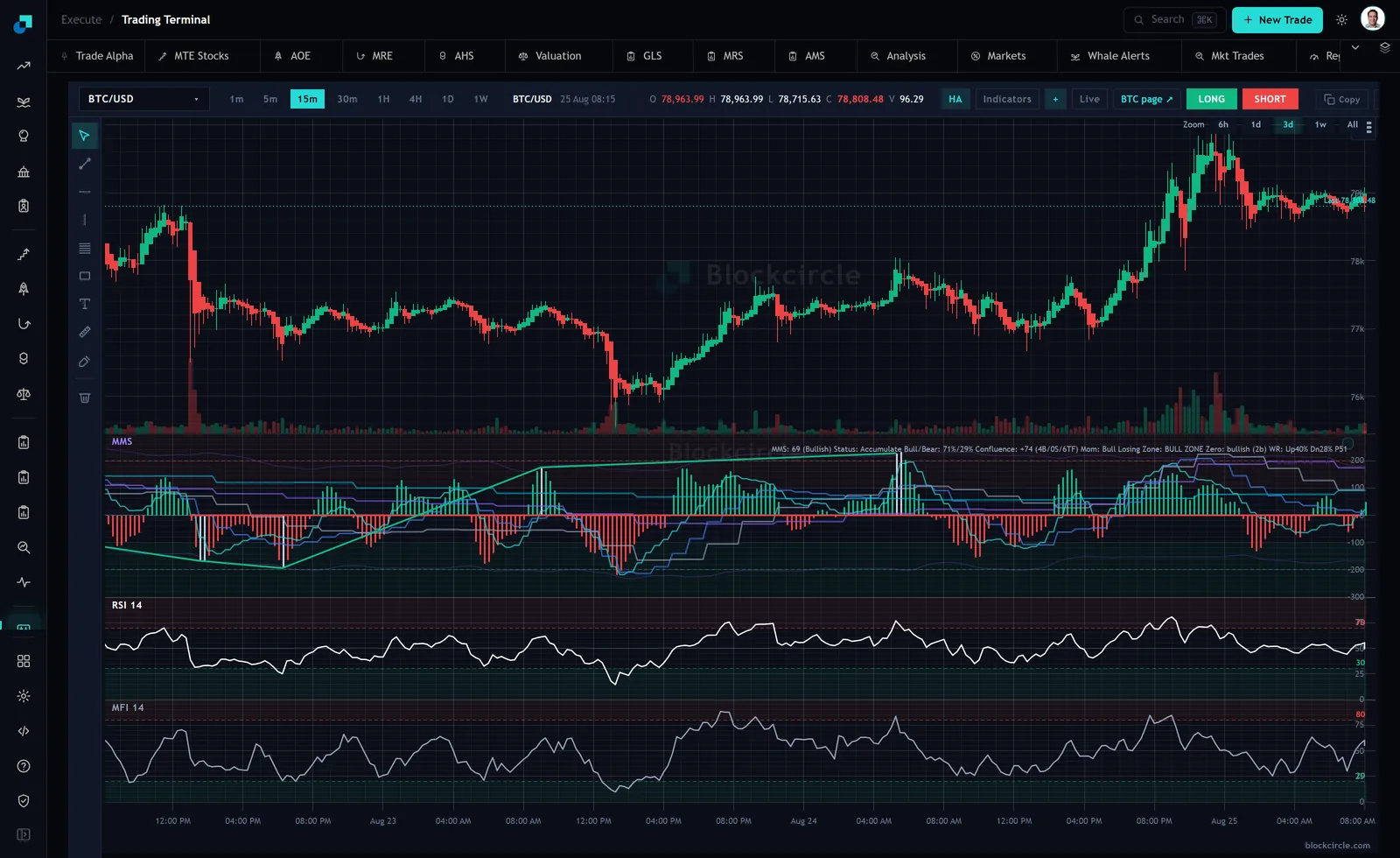
The MMS pane sits directly under the price chart, above RSI 14 and MFI 14, and its legend runs along the top of the pane in a single row. At the time of the capture below it read as follows.
MMS 85, tagged Strong Bullish. Status, Strong Buy Zone. Bull/Bear, 76 percent against 24 percent. Confluence, +89 with a 5B/0S/6TF breakdown. Mom, Bull Weakening. Zone, BULL ZONE. Zero, bullish with an 0b beside it. WR, Up40 percent, Dn28 percent, P46.
Seven readings, and only two of them are about direction. The rest are about conviction, breadth, freshness and base rate, and those are the inputs to how you execute rather than what you execute.
Score and status set your patience
MMS 85 with a Strong Bullish tag is the headline, and the platform treats 80 as a meaningful level elsewhere in the product. The Alert Builder exposes conditions written as MMS above 80 and MMS below -80, which tells you the scale is symmetric around zero and that 80 is the boundary the platform itself considers worth waking you up for.
What a reading in the eighties changes about your order is this. A market that is scoring at the top of its range is a market where the passive side of your order has already been picked off. Sitting a limit well below the offer and expecting the market to come and get you is a low probability plan when the score is 85, and a perfectly reasonable one when it is 30. The score is not telling you the trade is good. It is telling you what your fill probability looks like if you try to be clever about the entry.
Status, Strong Buy Zone, is the same information in words. Treat the two together as one field, not two confirmations.
Two kinds of agreement that get confused
Bull/Bear at 76 percent against 24 percent and Confluence at +89 look like the same thing said twice. They are not, and the difference is worth understanding because they fail in different ways.
The Bull/Bear split is a proportion. It says roughly three quarters of what the scorecard is weighing leans bullish. A 76/24 split still has a quarter of the evidence pointing the other way, which is normal and healthy.
Confluence carries a breakdown, and the breakdown is where the useful detail is. The 5B/0S/6TF notation resolves as five bullish and zero bearish across the six timeframes the scorecard covers, leaving one neutral. The number that should catch your eye is the zero, not the five.
Zero dissent is an execution warning as much as a directional endorsement. When nothing on any timeframe is arguing the other way, there is nobody at the other end of a patient limit order, and the market does not usually pause to let you in politely. Practically, that means a resting limit twenty basis points under the offer is unlikely to fill, and your realistic choices narrow to paying the offer or waiting for the confluence to fracture. When the breakdown shows a genuine split, say 4B/2S, you have a market with two opinions in it, and a market with two opinions gives you pullbacks to buy.
The disagreement between Mom and Zone
Mom reading Bull Weakening while Zone reads BULL ZONE is the most decision relevant pairing on the strip, and it is the one I look at before anything else.
The two fields are measuring different things. One is the state you are in. The other is the direction that state is travelling. Bullish and strengthening is a market you may have to chase. Bullish and weakening is a market that is still yours but has stopped running, and the correct response to a trend that has stopped running is to stop paying for immediacy.
In practice that means the entry gets broken up. If your intended position is 3,000 dollars, put a third in with a limit at or inside the touch, and leave the rest as resting orders lower down. If the weakening resolves back into strength you own a third of your intended size in a market that just proved itself, which is an acceptable outcome. If it resolves into a pullback you get the rest cheaper, which is the outcome the strip was pointing at.
Zero reads bullish with 0b beside it at capture. Freshness of a state matters, because a signal that has just flipped and one that has held for a long stretch are different trades with different stop distances. If you are going to lean on this field, confirm on your own chart what the counter beside it is counting before you size off it.
What a 40 percent hit rate does to your order type
The WR block at the end of the line read Up40 percent, Dn28 percent, P46 at capture. Take the headline at face value and ask what it implies operationally.
Forty percent is a base rate, not a forecast, and it is a base rate captured at one moment on one instrument on one timeframe. It will read differently tomorrow. But a hit rate below half, which is entirely normal for momentum systems that make their money on the size of winners rather than their frequency, has a hard consequence for how you enter.
If six trades in ten do not work, then every basis point you spend crossing the spread is spent six times for every four times it earns anything. Say you trade 3,000 dollars a position and a hurried market order costs you fifteen basis points more than a patient limit would have. That is four dollars and fifty cents. Four entries a week is eighteen dollars, which is nine hundred dollars over a year of doing it, and the win rate means most of that spend attaches to trades that were going to lose anyway.
So the rule the WR field gives you is not about direction. It is that at a hit rate this side of fifty percent you have to be structurally unwilling to pay for immediacy unless something else on the strip says the market is about to leave. Reserve the market order for the case where the score is high, the confluence has no dissent in it, and Mom reads strengthening rather than weakening. That configuration is the one where waiting genuinely costs you the trade. The configuration in this capture, strong but weakening, is the one where waiting costs you nothing and saves you the spread.