Two rows on the listings ledger can look almost identical and be completely different instruments. Same style of ticker, same date, same LISTED chip. One of them is a token you can buy and hold in a wallet. The other is a derivative contract that never delivers the token, charges you a fee every few hours for holding it, and can be closed out by the venue whether you agree or not.
The distinction is not decorative. It changes what moves the price, what the position costs per day, and whether you actually have an exit. Getting it wrong usually shows up as a position that is right about the token and still loses money.
Telling them apart on the row
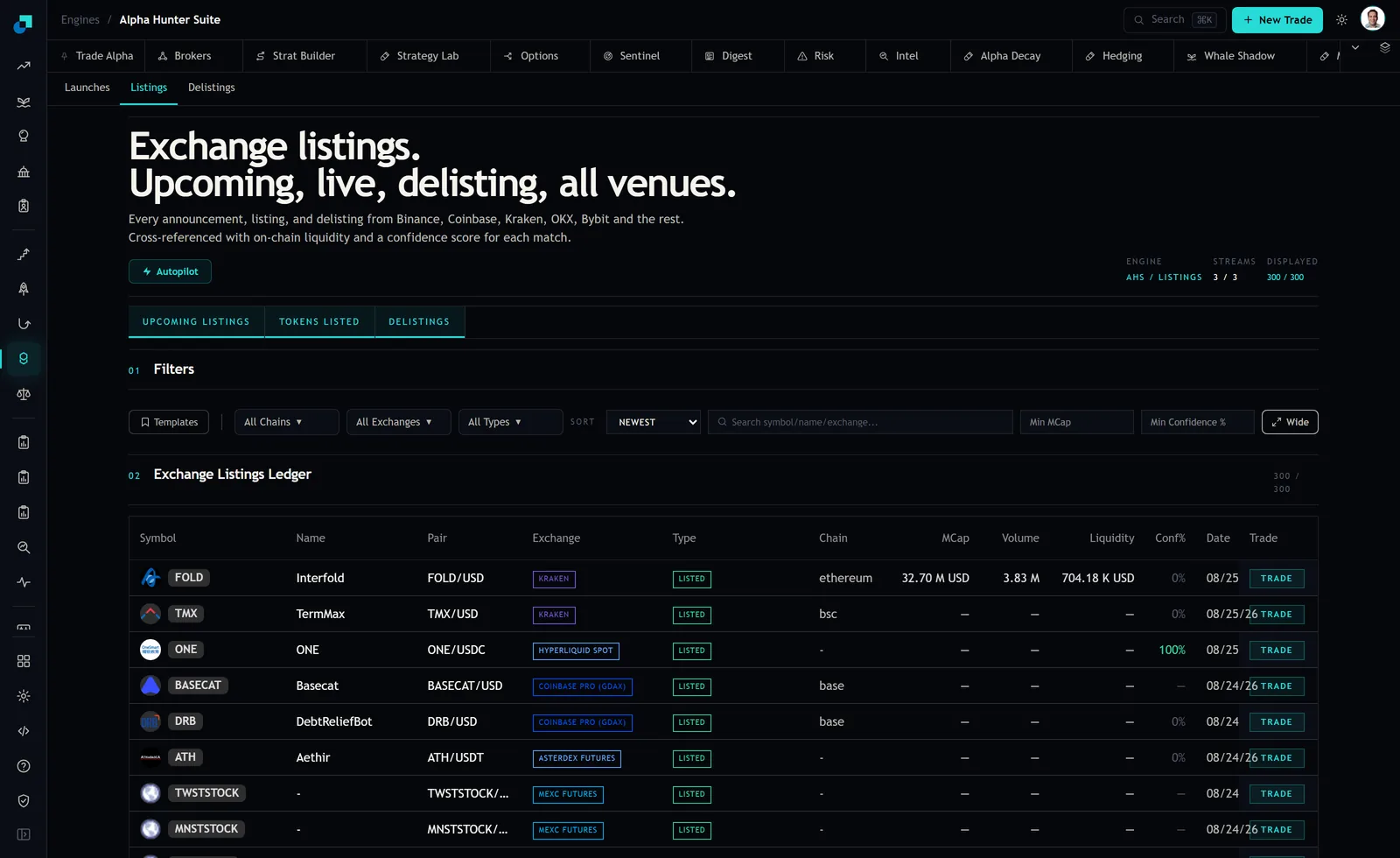
The tell is the venue chip, and this catches people out because it is not where you would look first. On the ledger at capture, ATH/USDT was listed on Asterdex Futures and two rows further down TWSTSTOCK and MNSTSTOCK were on MEXC Futures. Above them sat ONE/USDC on Hyperliquid Spot, and FOLD/USD and TMX/USD on Kraken.
The word Futures in the exchange label is doing the work. The Type column, meanwhile, shows LISTED, which is the state of the listing rather than the kind of instrument. A perp row and a spot row both say LISTED because both have gone live.
Two more clues sit on the futures rows. The chain field on both MEXC Futures rows shows a dash, and the Name column is empty. That is the reading you would expect where there is no on-chain asset behind the contract at all, which is exactly the situation with a derivative on something that has no spot token you can hold.
What sets the price when there is no spot market
A spot listing joins an existing market. If the token already trades on chain or on another exchange, the new venue's price is anchored by arbitrage, because anyone can buy in one place and sell in the other.
A perp on a token with no accessible spot market has no such anchor on that venue. What holds it near a reference is the funding mechanism, which periodically transfers payments between longs and shorts to push the contract price back toward an index. That is a much softer tether than arbitrage. It works over hours rather than instantly, and it works by making one side pay rather than by anyone actually delivering the asset.
The practical consequence is that perp-only markets can hold a persistent premium or discount to whatever you think fair value is, and there is no mechanism available to you personally to close that gap. On a spot listing, if the venue is expensive you can bring tokens in and sell them. On a perp, you can only take the other side and pay funding while you wait to be right.
Funding is a cost per hour, not a cost per trade
This is where most of the damage happens, because retail sizing is built around per-trade costs and funding is not one.
Funding is typically settled at fixed intervals through the day. Work the arithmetic on an assumed rate to see the scale of the thing, and treat the rate as an assumption rather than a forecast: at a rate of five basis points charged three times a day, holding costs about 0.15 percent per day, roughly one percent a week and roughly four and a half percent a month, on the notional rather than on the margin you posted. Rates on newly listed contracts are frequently higher than that and they move.
Two things follow. First, a perp position has a shelf life that a spot position does not, and the thesis has to resolve inside it. A view that is right in three months is a losing trade in a perp that costs you four percent a month to hold, and no amount of being right about the token fixes that.
Second, funding is the number to check before entry, not after. On a freshly listed contract where everybody wants the same side, the crowded side pays, and the crowded side is usually long. Check the current rate and the recent history of it, decide the total funding cost you are willing to pay for the trade, and convert that into a maximum holding period. That is the discipline, and it takes a minute.
The exit route is where the two really diverge
On spot you own an asset. If the venue delists the pair, you can usually withdraw the token and sell it somewhere else. The listing is a place to trade, not the thing you own.
On a perp you own a contract with that venue, and there is nothing to withdraw. Your exit is closing the position, which means finding a counterparty on that venue's book. If the book thins, your exit thins with it. If the venue delists the contract, it does not hand you tokens, it settles the position by its own rules at a price it determines, and you have no vote in that.
Then there is liquidation, which has no spot equivalent at all. A leveraged perp position has a price at which the venue closes it for you, and that price does not care that the market came back an hour later. A spot position that falls fifty percent is a spot position that fell fifty percent. A perp position that falls fifty percent with leverage on may simply no longer exist.
These are also the reasons a perp-only listing is a poor vehicle for a long-term view on a token and a reasonable vehicle for a short-dated directional trade with a defined stop. The instrument is fine, it is just an instrument for a different job than the one people usually hire it for.
The three checks before you take a futures row
First, confirm what you are looking at. Read the exchange chip rather than the Type column, and if the row shows a futures venue with an empty name and a dash for chain, assume there is no spot asset behind it until you have found one yourself.
Second, size on notional. Leverage means the margin you post is not the size of your position, and every risk number that matters, funding cost, liquidation distance, and what happens on a twenty percent move, is calculated on the notional. Decide the notional first and let the margin be whatever it needs to be, not the other way round.
Third, write down the funding budget and the holding period it implies before you enter, and treat the expiry of that period as a reason to close regardless of where the price is. A perp does not expire, which is exactly why your discipline has to.