A tender offer is the one corporate action where nothing happens to your shares unless you personally do something. No vote is taken on your behalf, no majority carries you along, and if you ignore the mail you simply keep what you own. That makes it the corporate action most worth understanding properly, because the decision is genuinely yours and it has a deadline.
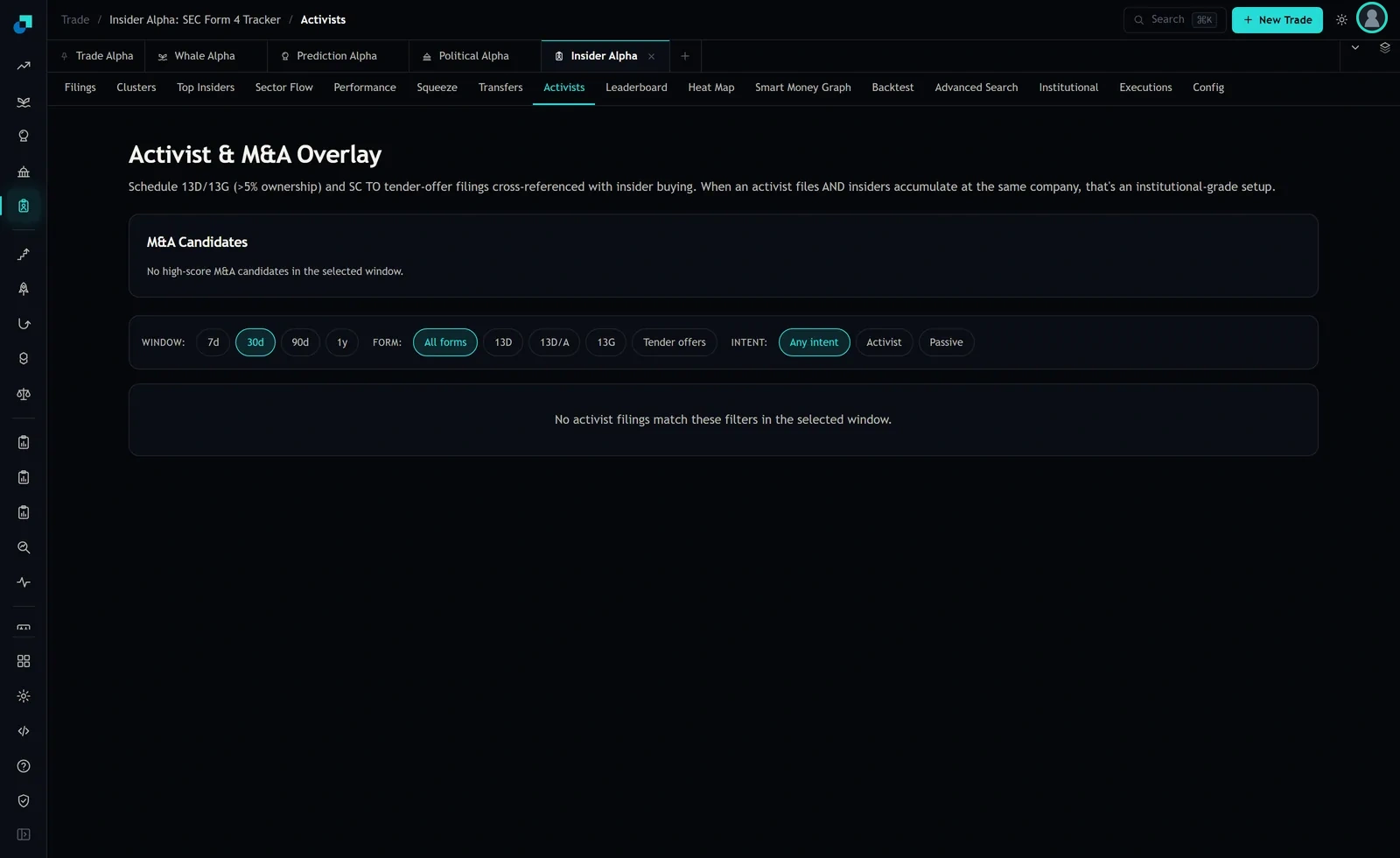
The Activists tab in Insider Alpha carries tender offers as one of its filing types, sitting alongside the 13D, 13D/A and 13G options on the FORM row. That grouping makes sense once you have seen a few. The same holders who accumulate through the market also accumulate through tenders, and a tender is frequently how an activist situation resolves.
A tender asks you, a merger vote asks the shareholder base
In a merger, shareholders vote. If the vote carries, your shares are converted into whatever the deal consideration is whether you voted for it or not. Your individual view stops mattering the moment the threshold is met.
In a tender offer, a buyer offers to purchase shares directly from holders at a stated price. You accept by tendering, you decline by doing nothing. The offer either gets enough shares to satisfy its conditions or it does not. Nobody converts your position without your instruction.
The two are frequently stitched together. A buyer runs a tender, gets a large majority, and then uses a back end merger to acquire the shares of holders who did not tender, at the same price. If that is the structure, holding out gains you nothing except a delay in getting paid, and the offer documents will say so. If it is not the structure, holding out leaves you as a minority holder in a company that now has a controlling shareholder, which is a materially worse position than the one you were in.
The conditions are the offer
The price is the headline and the conditions are the substance. Almost every offer is conditioned on a minimum number of shares being tendered, on regulatory clearances, on financing where the buyer needs it, and on nothing catastrophic happening to the business before closing.
The minimum condition is the one that decides whether the deal happens. If the buyer needs a majority and gets forty percent, the offer fails and everything unwinds. Read that number and then form a view on whether it is achievable given who is on the register. A company where three institutions hold half the stock is a very different proposition from one held broadly by retail.
The offer has to stay open for a minimum of twenty business days under the tender offer rules, and it gets extended when terms change or when conditions are still outstanding. Extensions are normal and are not by themselves a sign of trouble. A repeatedly extended offer with a minimum condition that is not being met is a different matter.
Proration decides how many shares actually leave your account
This is the arithmetic that catches people, and it only applies to partial offers, meaning offers for a fixed number of shares rather than any and all shares.
Say a company offers to buy back 20 million of its 100 million shares at a stated price. Holders tender 60 million. The buyer is only taking 20 million, so acceptances are prorated. The factor is 20 divided by 60, one third.
You tendered 900 shares. Roughly 300 are bought at the offer price. The other 600 are returned to your account, and they are returned at whatever the market price is after the offer closes, which is usually below the offer price because the offer price contained a premium and the offer is now over. Your realised outcome is a blend, and the stub you get back is the part nobody plans for.
So the question to answer before tendering into a partial offer is not "is this price good". It is "is this price good on a third of my shares, with the rest marked back to the post offer price". Work that number. On a 900 share position it is the difference between a decision that makes sense and one that quietly does not.
Odd lots and the withdrawal window
Two features that favour small holders and are routinely missed.
- Many offers, particularly issuer buybacks, include an odd lot preference. Holders of fewer than 100 shares who tender all of their shares have them accepted in full, ahead of proration. If you hold 80 shares and the offer has this provision, you get the full premium on all 80 while a large holder gets a third. Check the offer document for it, because it is not universal.
- You can withdraw a tender while the offer remains open. Tendering is not irreversible until the offer closes. That means there is no advantage to tendering on the last afternoon in a panic, and no penalty for tendering early and changing your mind if the terms move.
The withdrawal right also removes the argument for waiting. People hold off deciding because they want to see where the stock trades, then miss the deadline. Tender early, keep watching, withdraw if something changes. The failure mode here is administrative, not analytical, and it is entirely avoidable.
The decision on the last week
If you hold a name with a live offer, the practical sequence is short.
First, find out whether it is any and all or partial. Any and all means no proration and the decision is simply whether you like the price. Partial means you need the blended number above.
Second, find out what happens to shares you do not tender. If there is a back end merger at the same price, holding out is a timing decision, not a valuation one. If there is not, you need a view on being a minority holder under a new controlling shareholder, and for most retail positions that view should be no.
Third, check your broker's internal deadline. Brokers close their books ahead of the official expiry, sometimes by a couple of days, because they have to aggregate instructions. The date on the offer document is not the date that applies to you. I have seen more people miss a tender through this than through any misjudgement about the price.
Fourth, if the offer is a Dutch auction where you choose a price within a range, understand that specifying a high price maximises your proceeds if you are accepted and maximises the chance you are not accepted at all. Choosing the bottom of the range accepts the lowest price but is the most likely to be taken. There is no free choice in that trade off, and the offer document will not make it for you.