Two reporting regimes sit on top of the same shareholder register and they were written to answer different questions. One asks who is trading, at the transaction level, and covers the people closest to the company. The other asks who owns, at the position level, and covers anyone large enough to matter to control.
Above ten percent, a holder is inside both. That overlap is where most cross stream analysis of ownership data goes wrong, and it goes wrong quietly, in a direction that flatters whatever you were hoping to find.
Two statutes, two thresholds, one holder
Section 16 reporting attaches to officers, directors and beneficial owners of more than ten percent of a registered class. Those parties file transaction reports covering their trades in the issuer's securities, with a transaction code, a date, a share count and a price. This is the stream behind the Filings tab in Insider Alpha.
Section 13 ownership reporting attaches above five percent of a class. Those filers report a position, a percentage, a source of funds and, on the long form, a purpose. Amendments follow when something material changes. This is the stream behind the Activists tab.
A holder who accumulates through ten percent therefore acquires a second, entirely separate reporting obligation without any change in what they are doing. The same accumulation now produces documents in both places, describing the same money at different resolutions. One tells you the trades. The other tells you the position and the intent. Neither is a subset of the other and neither carries a pointer to the other.
Where the two streams meet inside the module
They meet in the tab strip and nowhere else, which is worth seeing plainly.
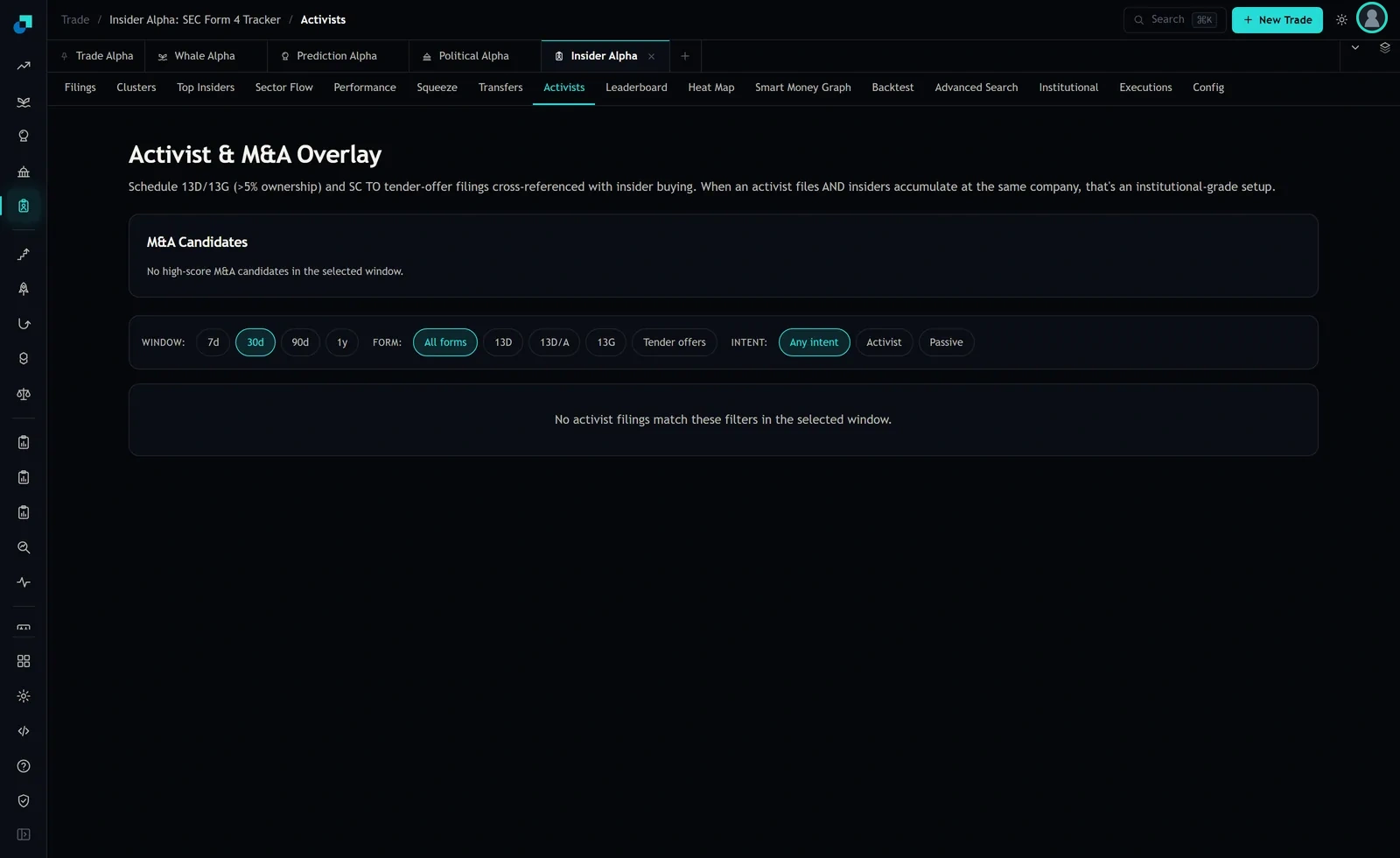
The overlay's own premise, printed under its title, is that an activist filing occurring alongside insider accumulation at the same issuer is the setup worth finding. That premise is sound when the two are independent parties. It is empty when they are the same party, and nothing on either screen prevents you from being in the second case while believing you are in the first.
The module also keeps a Clusters tab for multiple insiders buying the same name inside a window. Whether that cluster logic treats a ten percent holder the same as an officer is not shown on the Activists page, so verify it against your own definitions before you let a cluster flag feed a model. The distinction matters and I will come back to it.
The join key that does not exist
There is no transaction identifier shared between the two regimes. What you have to work with is imperfect in three specific ways.
Entity identity is the first problem. The reporting person on a transaction report is identified by a regulator issued identifier and a relationship indicator. The ownership filer is identified the same way, but the entity that actually holds the shares is frequently not the entity named on the transaction report. Funds hold through vehicles, advisers report on behalf of managed accounts, and the legal structure between the two documents can be several layers deep.
Group membership is the second. An ownership filing can be made by a group whose members each have their own identifiers. A join on a single filer identity will match one member and miss the rest, which means your dedupe catches some of the double count and leaves the remainder in place. That is worse than catching none of it, because the residual looks like a clean signal.
Granularity is the third. A transaction report covers one trade or a small set of trades on specific dates. An ownership amendment covers a position change that may aggregate weeks of buying into a single percentage. Matching share counts between them will frequently fail even when the same money is involved, because the documents are not describing the same unit of activity.
The workable approach is layered. Join on entity identity where the identifiers match directly. Fall back to a maintained mapping of filer to affiliated reporting entities, built up over time from the group member lists in the filings themselves. Accept that a residual fraction will not match, measure that fraction, and report it alongside anything the join produces. A join with an unstated match rate is a number without an error bar.
Deduping a purchase that legitimately appears twice
The policy is simpler than the join. Pick one stream as the source of record for each kind of fact and never let both increment the same counter.
The ownership amendment is the source of record for the position. It carries the percentage, and the percentage is what matters for control, for the five percent and ten percent lines, and for anything about influence.
The transaction report is the source of record for the trade. It carries the code, the date and the price, which is what you need for anything about timing or about what the buyer was willing to pay.
The failure to avoid is an event counter that increments on both. If your desk tracks something like insider buying events per issuer per month, and a ten percent holder's purchases flow into it from both directions, that series is inflated for exactly the large holders whose activity you care most about. The distortion is concentrated in the tail, which is where the decisions are.
Implement the exclusion explicitly rather than relying on the join to handle it. Before a transaction report contributes to any cross stream measure, check whether its reporting person maps to the ownership filer or to a listed group member at that issuer. If it does, it contributes to the trade record and not to the confluence count.
What the double count does to a confluence screen
Run a screen that looks for an activist filing and insider buying at one issuer inside a short window, without the exclusion, and a meaningful share of your hits will be a single participant recorded twice. Those hits are not weak signals. They are not signals at all. They are an artefact of two statutes describing one decision.
Apply the exclusion and ask what is left. If officers and directors were also buying, independently, in that window, then you have the situation the premise describes, two constituencies with different information reaching the same conclusion. That set will be much smaller. It is also the only version of the set that means what you think it means.
There is a second reason to keep them separate, beyond the counting. The information content differs. An officer buying is someone with operational knowledge of the business committing personal capital. A ten percent holder buying is a professional investor adding to a thesis you can largely reconstruct from their own filings. Both are worth knowing. Weighting them equally inside a single insider buying factor blends a knowledge signal with a conviction signal, and when the factor stops working you will have no way to attribute which half failed.
Store the role alongside every transaction and keep the two series separate all the way through to attribution. It costs one column, and it is the difference between a factor you can diagnose and one you can only switch off.