Every allocation memo on a new token contains a claimed circulating float, and almost none of them contain a reconciliation. The number arrives from a project deck or a data aggregator, gets copied into the valuation, and then quietly determines everything downstream: the implied fully diluted figure, the unlock schedule's significance, and the size at which your position becomes a meaningful share of the tradable supply.
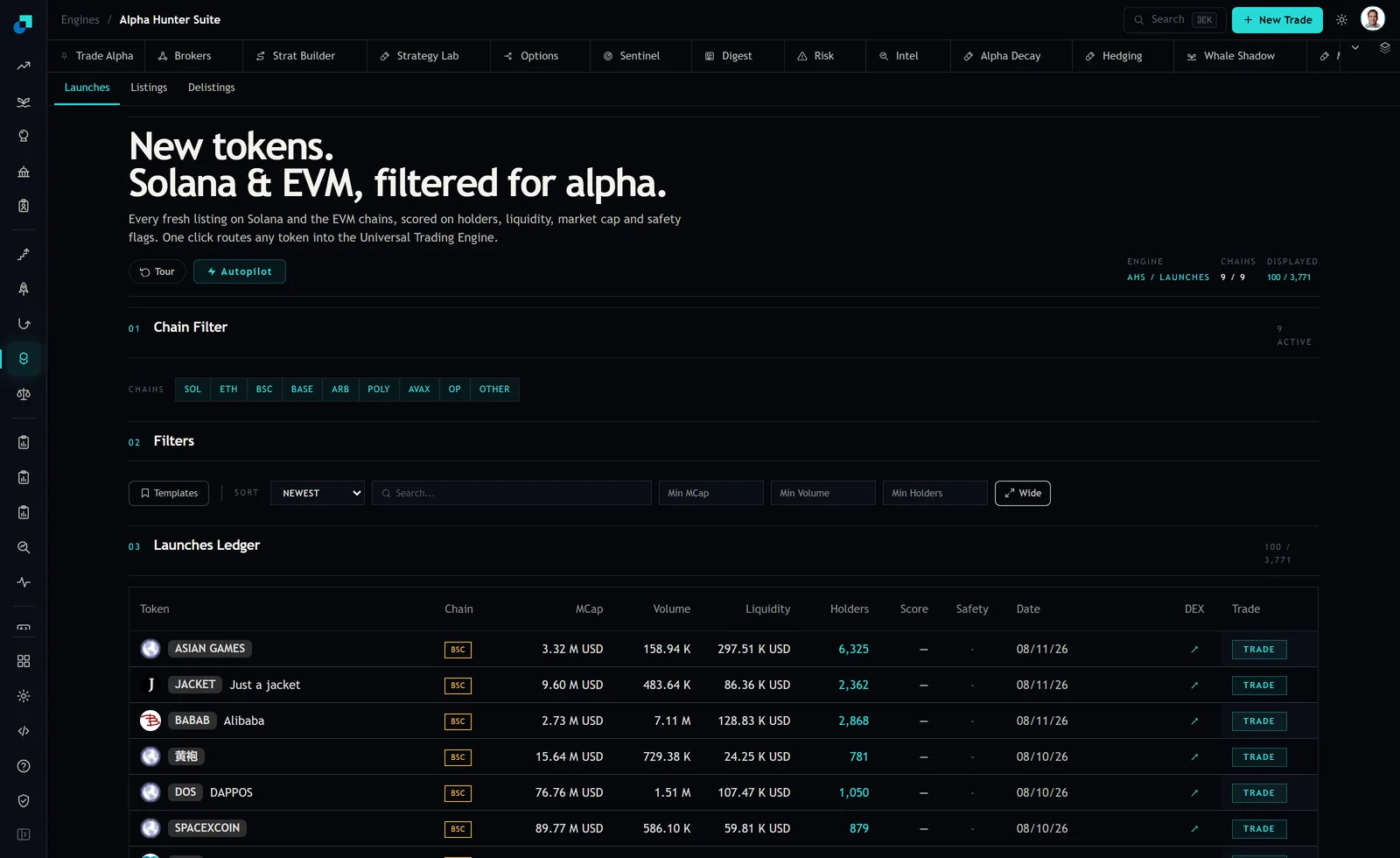
It is a claim, and it is checkable. The check is not difficult, it is just multi-source, and the reason it does not get done is that no single screen contains all the inputs. Worth saying plainly at the start: the launches ledger does not have a supply column. It gives you a market cap, a holder count, pool depth, volume and a link out to the DEX. The reconciliation is assembled from those plus the contract, and knowing which term comes from where is most of the discipline.
The identity, and which term is missing
Market cap equals price multiplied by circulating supply. Three terms, and any two of them determine the third. That is the whole apparatus.
The ledger gives you market cap directly. It gives you a route to price, because the DEX link resolves to the pool where the last trade happened. It does not give you supply, and it does not give you the issuer's definition of circulating, which is the term everybody argues about and nobody writes down.
So the reconciliation runs in the direction the data allows. Take the cap from the row, take the pool price from the venue, and derive the supply the cap implies. Then compare that derived supply against the contract's total supply and against the claimed circulating figure in the memo. Three numbers that should sit in a sensible relationship to each other, and when they do not, the disagreement tells you which source is wrong.
The procedure, in the order that fails fastest
Order the steps so the cheapest disqualifier runs first. Most candidates die at step two and there is no point doing holder analysis on a token that has already failed an arithmetic check.
- Read cap and holder count off the row and record them with a timestamp. Both move, and a reconciliation without a timestamp is not reproducible.
- Pull total supply and decimals from the contract itself, not from an aggregator. Decimals are where the factor-of-a-thousand errors come from and they are the single most common cause of a reconciliation that appears to fail spectacularly for no reason.
- Derive implied circulating supply as cap divided by pool price, and express it as a percentage of total supply. That percentage is the float the market data is implicitly asserting.
- Compare that implied float against the claimed float. State a tolerance in advance. A few percent of disagreement is data latency. A factor of two is a definitional dispute. An order of magnitude is not a dispute, it is a different token.
- Enumerate the largest holding addresses and classify each one: pool, bridge, exchange omnibus, treasury, team, unknown. Only then subtract what genuinely cannot trade.
Step five is where judgement enters and it should be exercised conservatively. A treasury address with no lock on it is freely transferable supply that happens not to have moved. Counting it as non-circulating because the issuer says it is not circulating is accepting the claim you set out to test.
The holder count as an independent check on the same claim
The holder column is the cheapest cross-check available and it is almost never used, because it looks like a popularity metric rather than a supply one. Divide market cap by holder count and you get the average dollar value held per address, which is a number with a strong prior attached.
Take two rows from the ledger at capture. One showed a 3.32 M cap against 6,325 holders, which averages roughly 525 dollars per address. That is consistent with a broad retail distribution. Another showed an 89.77 M cap against 879 holders, which averages roughly 102,000 dollars per address. That is not a retail distribution under any reading. It is either a token held by a small number of very large positions, or a cap that is not real, and both of those change the allocation.
The check does not tell you which. It tells you that a claimed float described as widely distributed is inconsistent with the holder count on the row, and that inconsistency is a question for the issuer rather than a conclusion about them.
The four discrepancies that stop the allocation
Write these as gates rather than as considerations, because a consideration gets weighed against enthusiasm and a gate does not.
First, implied float and claimed float disagree beyond your stated tolerance and the difference is not explained by a definitional gap you can identify. Not explained is the operative phrase. An unexplained factor of three is disqualifying even if a plausible explanation might exist.
Second, supply is mutable. If the contract permits minting, or the authority to change supply has not been demonstrably renounced, then every float figure in the memo is a snapshot of a quantity the issuer controls, and the valuation has no denominator. This is a binary gate, not a scored one.
Third, the addresses excluded from float are not actually restricted. Excluded supply must be excluded by something enforceable. A vesting contract counts. An intention does not.
Fourth, the position you want is large relative to the float you just verified. This is the gate people forget because it is about you rather than about the token. If a verified float is thin enough that your intended size is a double-digit percentage of it, then the reconciliation succeeded and the allocation still fails, because you have become the market rather than a participant in it.
Making it reproducible instead of doing it once
The output of this work is a short memo with the three sources named, the timestamp on each, the derived figures, and the tolerance that was applied. Anyone should be able to rerun it and get the same answer or find out why not.
Attach a re-run trigger rather than a review date. Supply reconciliation should repeat when the contract changes, when a scheduled unlock passes, and when market cap moves materially without a corresponding price move, because that last combination is the signature of a supply figure changing underneath you.
And record the limit of what the exercise proves. This is a consistency test between sources, not an integrity test on any of them. A token can pass every step here and still be held by five wallets that coordinate, and the reconciliation will report a clean float the whole way through. What it buys you is the elimination of a specific and common failure, which is a valuation built on a denominator nobody checked.